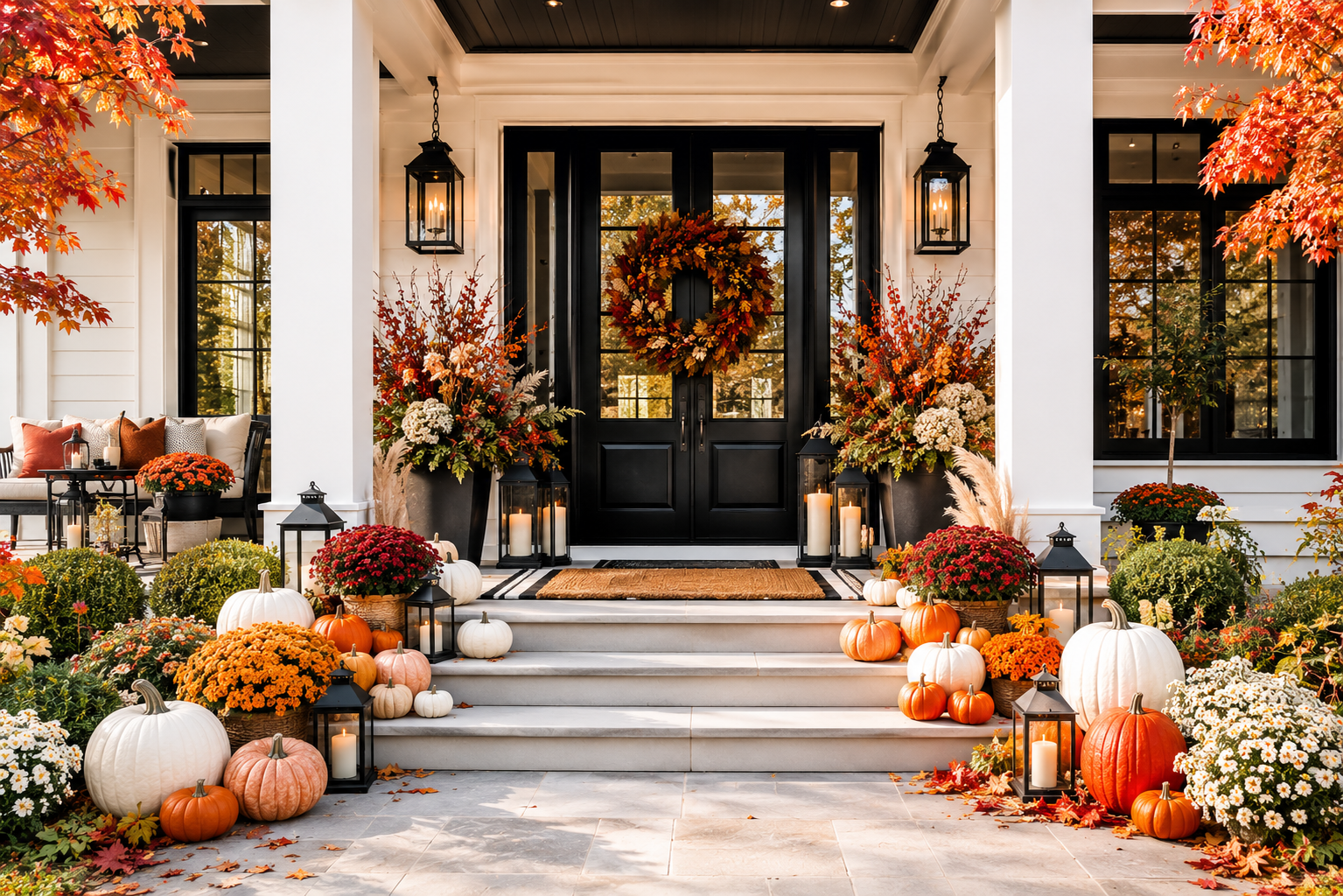
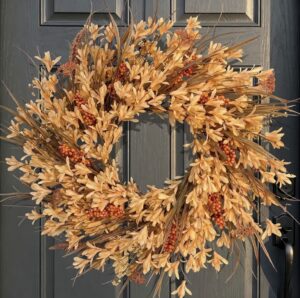
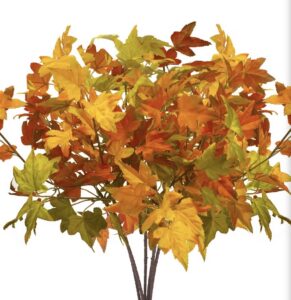
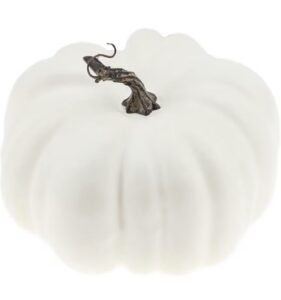
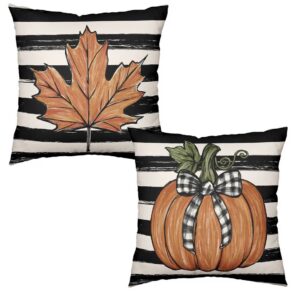
The secret to a beautiful fall porch is not adding more décor. It is creating stronger layers, better balance, and a clear path for the eye to follow.
There is something about decorating the front porch for fall that immediately makes a home feel warmer and more welcoming. The colors are richer, the light becomes softer, and even a simple collection of pumpkins and flowers can completely change the feeling of an entrance.
But fall decorating can also go wrong quickly. Too many small pumpkins, scattered accessories, competing colors, and decorations placed everywhere can make even a beautiful porch feel crowded.
I prefer a fall entrance that feels abundant but still elegant—a porch that can carry the home from early fall through Halloween and even into Thanksgiving with only a few small changes.
The goal is not to fill every empty space. It is to create a layered composition that makes the front door feel like the natural focal point.
Start With the Architecture, Not the Decorations
Before placing a single pumpkin, look carefully at the shape of your porch.
Notice:
The width of the steps
The height of the front door
The placement of columns
The size of the lanterns
The available floor space
The natural walking path
Your decorations should frame the architecture rather than compete with it.
On a large porch, small decorations can disappear. Larger planters, oversized pumpkins, tall branches, and substantial lanterns will look more proportional. On a smaller porch, fewer pieces with stronger shapes will create more impact than dozens of tiny accessories.
A useful rule is to let the house determine the scale.
Create a Visual Triangle Around the Door
One of the easiest ways to make a porch look professionally styled is to build a visual triangle.
The top point is the wreath or decoration on the door. The two lower points are created by planters, lanterns, or larger pumpkin groupings on each side.
This keeps the eye moving toward the entrance instead of wandering across a collection of unrelated decorations.
The triangle does not need to be perfectly symmetrical. In fact, a slightly uneven arrangement often feels more natural. The important part is that the visual weight remains balanced.
Use the 70–20–10 Color Formula
One reason fall porches can start to look chaotic is that every autumn color is used in equal amounts.
A better approach is to divide the color palette into proportions:
70 percent dominant color
20 percent supporting color
10 percent accent color
For this porch, white and black form the dominant foundation. Orange and rust provide the supporting color, while deep red adds a smaller, dramatic accent.
This technique prevents the décor from becoming visually noisy and allows each color to feel intentional.
You can use the same formula with other palettes:
Cream, copper, and burgundy
White, sage green, and amber
Black, orange, and plum
Brown, ivory, and muted gold
Repeat Each Color at Three Different Heights
This is one of the simplest styling techniques, but it makes an enormous difference.
Do not place all the orange pumpkins along the ground or all the red flowers at the same level. Repeat each important color at three heights:
Ground level
Step or planter level
Eye level
For example, orange may appear in pumpkins along the walkway, chrysanthemums on the steps, and autumn branches near the door.
Repeating the color vertically creates continuity and makes the entire porch feel connected.
Build in Layers From Back to Front
A beautifully decorated porch should have depth.
Start with the tallest elements closest to the house:
Tall branches
Large planters
Cornstalks
Ornamental grasses
Upright greenery
Move forward with medium-height pieces:
Chrysanthemums
Lanterns
Baskets
Medium pumpkins
Finish with lower elements:
Small pumpkins
Gourds
Fallen leaves
Low flower pots
This back-to-front layering is what makes the porch feel full without looking like everything was placed in one flat row.
Use Fewer, Larger Pumpkin Groupings
Scattering individual pumpkins everywhere often creates clutter.
Instead, create several deliberate pumpkin families.
Each grouping should include:
One large anchor pumpkin
One or two medium pumpkins
Two or three smaller pumpkins
Vary the colors, shapes, and stem directions.
A grouping of five pumpkins will usually look more refined than five pumpkins placed separately across the same area.
Odd-numbered arrangements also tend to feel more natural and visually interesting.
Place Pumpkins Where They Would Naturally Collect
A small detail that makes a porch feel more realistic is placing pumpkins where objects might naturally gather.
Good locations include:
At the base of a planter
Beside the edge of a step
Near a lantern
Along the outer edge of a walkway
Beneath a bench
Beside the door
Avoid placing a single pumpkin in the middle of a large empty step. It often looks staged rather than intentional.
Let the pumpkins appear to settle around the larger decorative elements.
Turn the Steps Into a Gradual Reveal
Do not decorate every step in exactly the same way.
Instead, let the arrangement grow gradually as it approaches the door.
The first step might hold a small pumpkin grouping. The next could introduce flowers and a lantern. The upper steps can carry the most substantial arrangements and the greatest concentration of color.
This progression draws people toward the entrance and creates a sense of discovery.
It is the same principle used in formal garden design: the eye should be invited forward rather than shown everything at once.
Use White Pumpkins as Visual Resting Points
Bright orange pumpkins are beautiful, but too many can overwhelm a black-and-white house.
White pumpkins act as visual breathing room.
They break up the stronger autumn colors and connect the seasonal décor to white siding, columns, stone, or trim.
Larger white pumpkins are especially useful near the bottom of the arrangement because they visually anchor the display without adding more color.
Pair Flowers With Foliage, Not More Flowers
A porch filled only with chrysanthemums can start to feel repetitive.
To create a more sophisticated arrangement, combine flowers with foliage and textural materials.
Consider using:
Autumn branches
Seeded eucalyptus
Burgundy leaves
Magnolia foliage
Ornamental grasses
Dried hydrangeas
Pampas grass
Berry stems
The flowers provide color, while the foliage adds shape, movement, and depth.
This combination also makes store-bought arrangements look more custom.
Mix Fresh, Dried, and Faux Elements
There is no rule that says every element must be fresh.
In fact, combining materials often creates a porch that looks better for longer.
Use fresh chrysanthemums and pumpkins where they will be noticed up close. Add high-quality faux branches in tall planters where they are less likely to be examined closely. Dried grasses and seed heads can bridge the two.
This makes the arrangement easier to maintain and allows you to reuse the most expensive pieces each year.
The key is to place faux materials in larger arrangements rather than displaying a single artificial stem by itself.
Let Lanterns Create Rhythm
Lanterns should not all be the same size or placed at equal intervals.
Use two or three sizes and repeat them through the arrangement.
A tall lantern might sit beside the door, a medium lantern near the steps, and a smaller lantern closer to the walkway.
This creates rhythm and gives the eye a reason to travel across the porch.
For safety, use battery-operated candles with timers. They create a warm glow every evening without requiring daily attention.
Protect the Walking Path
A beautiful porch should still function properly.
Leave a clear path from the walkway to the front door. Guests should not have to step around pumpkins, lanterns, or trailing vines.
Keep décor away from:
The center of the steps
Door swing areas
Handrails
Walkway edges
Delivery drop-off areas
A useful test is to walk toward the door while carrying two grocery bags. Anything that feels inconvenient should be moved.
Make the Porch Last Through Thanksgiving
The smartest fall porch is designed in layers that can be edited rather than completely replaced.
For early fall, focus on foliage, mums, lanterns, and pumpkins.
For Halloween, add a restrained layer such as black ribbon, dark lanterns, a few elegant ravens, or black taper candles.
After Halloween, remove the darker accessories and add:
Copper accents
Wheat bundles
Dried corn
Warm plaid pillows
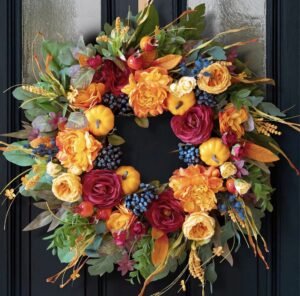
A harvest-style wreath
The foundation remains the same while the mood shifts.
Use a Seasonal Maintenance Plan
Fall displays need regular attention, especially in warm climates.
Once a week:
Rotate pumpkins to prevent soft spots
Remove damaged leaves
Trim dead flowers
Check the soil moisture in mums
Clean lantern glass
Sweep away excess fallen leaves
Replace any candle batteries
Do not assume chrysanthemums need water every day. Check the soil first. Overwatering can damage them just as quickly as allowing them to dry out.
Caroline’s Designer Trick: Decorate in Clusters, Then Photograph It
After arranging the porch, take a photograph from the street or walkway.
A photograph flattens the scene and makes imbalance much easier to see.
You may immediately notice:
One side looks heavier
The wreath appears too small
Several pumpkins disappear into the background
A lantern blocks another object
The colors are concentrated in one area
Professional stylists use photographs throughout the design process because the camera reveals problems the eye often overlooks.
This is one of the fastest ways to refine your own arrangement.
What Makes a Fall Porch Look Expensive?
It is rarely the price of the decorations.
A fall porch looks elevated when it has:
A limited color palette
Strong scale
Repeated materials
Layered heights
Clear focal points
Plenty of negative space
Thoughtful lighting
A visible path to the door
Ten well-placed pieces can look far more luxurious than fifty small decorations scattered everywhere.
Seasonal decorating should enhance the beauty of your home—not hide it beneath decorations.”
— Caroline
Shop the Style
Affiliate Disclosure:As an Amazon Associate, Things of Style earns from qualifying purchases. If you choose to shop through the links on this page, I may receive a small commission at no additional cost to you. Thank you for supporting Things of Style. Your support helps me continue creating beautiful recipes, entertaining inspiration, home décor ideas, travel guides, and carefully curated collections to share with you.
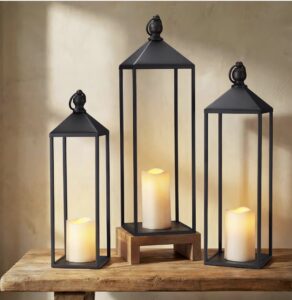
Large black lanterns add architectural weight and can remain on the porch throughout the year. Add battery-operated pillar candles for a soft evening glow.
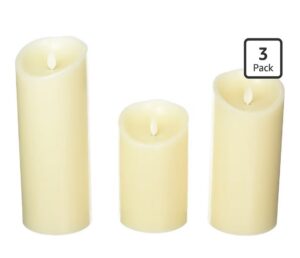
Timer/Remote candles are ideal for front porches because they switch on automatically each evening and eliminate the risks associated with open flames.